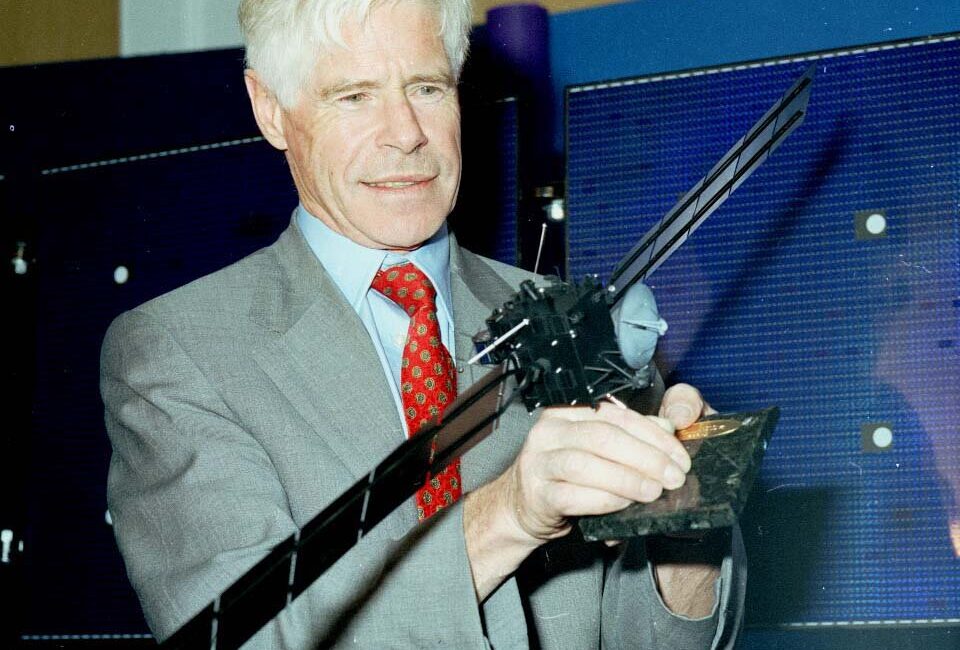
Prof. Roger-Maurice Bonnet passed away on January 19, 2026. He was elected a Corresponding Member for Section 1 on Basic Sciences in 1980 and a Full Member in 1985.
Born in Dourdan, France, Prof. Bonnet studied physics and astronomy and focused on solar physics in his early career. He launched the first French space astronomy experiment on board a Veronique rocket, from the Hammaguir launch base in the Sahara. His early work culminated in the building of the Transition Region Camera experiment in collaboration with the Lockheed Solar Physics group in Palo Alto, California, which obtained the best-ever pictures of the Sun in the Lyman-alpha radiation.
At the Laboratoire de Physique Stellaire et Planétaire LPSP, where he was Director from 1969 until 1983, he developed several space experiments with his teams. His laboratory was involved in the development of the infrared spectrometer on board the VEGA-1 and VEGA-2 Soviet missions and he developed the telescope for the Halley Multicolour Camera that flew on board ESA’s Giotto mission, which obtained the first image ever of the nucleus of a comet in 1986.
During his 18-year tenure as Director of the Science Programme at ESA, Prof. Bonnet established Horizon 2000, which incorporated a balanced blend of large, medium and small missions. The plan also identified a number of longer-term science endeavours to be studied in preparation for the post-Horizon 2000 era.
Professor Bonnet led the ESA Science Programme from 1983 to 2001, establishing the first long-term science programme, Horizon 2000. His contributions ensured Europe’s place at the forefront of space science, forging international collaborations and championing science missions, as well as ensuring that programmes were delivered efficiently – setting the standard for all of his successors.
Missions already approved, including the comet-hunter Giotto, the astrometry mission Hipparcos, the NASA/ESA Hubble Space Telescope, Ulysses also with NASA, and the Infrared Space Observatory (ISO) were integrated into the plan. The flagship missions (cornerstones) included the solar-terrestrial programme (SOHO/Cluster), XMM-Newton, Herschel and Rosetta. The first two medium missions approved were the ESA Huygens probe to Titan on board NASA’s Cassini mission to Saturn and Integral – the International Gamma-Ray Astrophysics Laboratory.
A new plan covering the period 1995-2015, called Horizon 2000 plus, was subsequently endorsed in 1996. Under this plan, the Planck mission (later merged with Herschel into one development programme), Mars Express, the SMART-1 lunar mission, Gaia, BepiColombo and LISA Pathfinder missions were approved. ESA’s involvement in the NASA-led James Webb Space Telescope mission was also decided in 1998, during Prof. Bonnet’s mandate. He was also entrusted with defining the European strategy for Earth sciences and observation, and from 2001 to 2006, he served as an adviser to the Director General on the Aurora programme of planetary exploration.
As Joint Director General for Science at the French space agency CNES, from January 2002 to January 2003, he helped to scope future science programmes towards 2015, and subsequently chaired a commission that led to a significant change in French space policy and reorganisation of the agency.
As President of COSPAR, Prof. Bonnet initiated an in-depth review of the committee and established the COSPAR Science Advisory Committee which is a unique platform where all science policy issues in the world are discussed.
Prof. Bonnet received numerous international honours and was appointed Officier of the French Légion d’Honneur. He was the author of more than 150 articles and scientific publications, with his final book to be published during 2026.
@credit: ESA