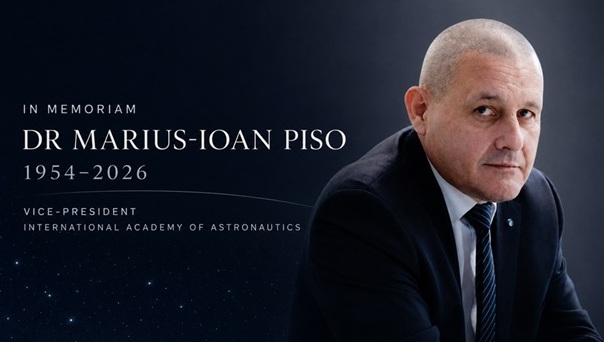
IN MEMORIAM: Dr Marius-Ioan Piso (1954-2026)
IAA Vice-President and a leading architect of Romania’s modern space programme
The international astronautical community mourns the passing of Dr Marius-Ioan Piso, Vice-President of the International Academy of Astronautics for Publications and Communication and one of the most influential architects of Romania’s modern space programme.
Dr Piso was a physicist, inventor, institution-builder and international leader whose career brought together fundamental research, technological development, space policy and international cooperation. His contribution extended far beyond the offices he held. He helped create institutions, open international opportunities for a new generation of specialists and establish Romania as an active participant in the European and global space community.
Within the International Academy of Astronautics (IAA), he was elected a Corresponding Member in 2004 and an Academician in 2007. He became one of the Academy’s most dedicated architects of scientific programs, studies, conferences, and international partnerships. In 2011, for example, he hosted the IAA Planetary Defense Conference in Bucharest, giving the series a strong impulse that helped make it one of the IAA’s most successful conferences.
He served on the Board of Trustees in 2013, became Chair of the Social Sciences Section in 2015, and served as Vice President for Publications and Communication from 2019 until his passing—contributing substantially to the IAA’s scientific and institutional development throughout. Under his leadership, the IAA’s journal Acta Astronautica rose to first place among the world’s roughly one hundred space-sector journals, publishing 2,300 pages in 2025. During this period its impact factor grew from 2.4 to 3.4, and annual article downloads increased from 699,000 to 2.2 million.
Space systems as critical infrastructure
One of Dr Piso’s most important intellectual and institutional contributions to the Academy was his pioneering work on the concept of space systems as critical infrastructure.
He understood at an early stage that satellites and space-based services could no longer be regarded solely as instruments for scientific discovery or technological prestige. Modern societies had become deeply dependent on them for communications, navigation, Earth observation, disaster management, financial services, transportation, security and governance.
In 2006, the International Academy of Astronautics established a study group dedicated to this subject under his leadership. The group brought together specialists from space engineering, security studies, risk analysis, law, economics, public policy and critical-infrastructure protection.
This work helped transform the subject from a largely technical concern into a coherent multidisciplinary field. It examined not only the vulnerability of satellites and ground segments, but also the consequences that the disruption of space services could have for terrestrial infrastructure, national economies, public institutions and civilian life.
Beginning in 2012, Dr Piso played a leading role in establishing the IAA Conference on Space Systems as Critical Infrastructure, organised in cooperation with the Romanian Space Agency. The conference developed into a long-running international series, bringing together researchers, policy-makers, representatives of space agencies, industry and security institutions.
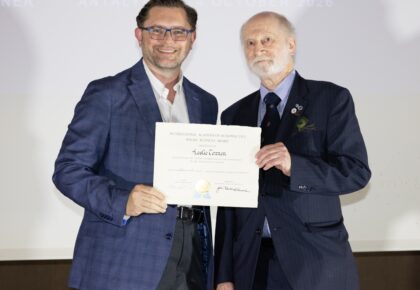
The resulting IAA study offered an assessment of the critical role of space systems in contemporary civilisation. Dr Piso’s work in this field was recognised through the IAA Social Sciences Book Award 2020, presented in March 2022, for the volume Critical Space Infrastructures: Risk, Resilience and Complexity.
Today, when the resilience of satellite communications, navigation, Earth observation and space-based security services has become a strategic concern worldwide, the relevance of this work is clearer than ever.
A scientist and inventor
Before becoming an institutional and international leader, Marius-Ioan Piso was a scientist.
His early research focused on gravitational radiation and its sources, followed by work on space-time structures and field theory. He received his PhD in Physics from Alexandru Ioan Cuza University of Iasi in 1994.
His activity also included experimental research and technological engineering. He developed new measurement principles and worked on high-performance inertial sensors for acceleration, vibration and motion measurement, including accelerometers, inclinometers and dynamic gradiometers using advanced magnetic nanofluids.
His scientific and technological work resulted in more than 20 national and international patents, demonstrating his ability to connect fundamental physics with practical instrumentation and engineering.
This combination of scientific depth and technological pragmatism remained a defining feature of his entire career. He believed that scientific knowledge should not end with publication, but should lead to instruments, technologies, capabilities and institutions.
Building Romania’s space institutions
Dr Piso played a central role in the establishment of the Institute of Space Science in Magurele in 1990. The Institute subsequently became one of Romania’s principal research centres in astrophysics, particle physics, cosmology, space technologies and satellite applications.
In 2005, he established a microsatellite group within the Institute, contributing to the development of the first Romanian satellite and to the creation of national expertise in microsatellite engineering.
For Marius-Ioan Piso, a satellite was never merely an object to be placed in orbit. It was an engineering school, a platform for training specialists and a necessary step towards building a sustainable national technological capability.
He was also directly involved in establishing the Romanian Space Agency – ROSA – beginning in 1990. When the Agency acquired legal personality in 1995, he became its first Executive Director. From 2004 until 2022, he served as President and Chief Executive Officer.
Under his leadership, ROSA became the principal interface connecting Romanian research organisations, universities and industry with European and international space programmes.
His most consequential institutional achievement was his contribution to Romania’s accession to the European Space Agency. This was not a ceremonial process. It required many years of negotiations, institutional preparation, technical evaluation and development of the Romanian scientific and industrial community.
Romania’s membership of ESA enabled its researchers, engineers, institutes and companies to participate in European programmes, compete for contracts and work within internationally recognised technological and quality standards.
In recognition of this historic contribution, asteroid 10466 was named Marius-Ioan. The official citation acknowledged his advocacy for space research in Romania and the more than two decades during which he orchestrated Romania’s path towards membership of the European Space Agency.
A voice for international cooperation
Dr Piso represented Romania for many years in the United Nations Committee on the Peaceful Uses of Outer Space – COPUOS – and later headed the Romanian delegation.
He was elected Chair of COPUOS for the 2020-2022 term, one of the most important international positions ever held by a Romanian space professional.
His work within the United Nations addressed near-Earth objects, planetary defence, microsatellites, global and regional coordination, disaster management and the long-term sustainability of outer-space activities.
He also represented Romania within COSPAR, the International Astronautical Federation and the Group on Earth Observations. Within NATO, he contributed to activities concerning science, security and the strategic importance of space technologies.
Dr Piso supported the organisation of major international scientific events in Romania, including the 2011 IAA Planetary Defense Conference in Bucharest. Through these initiatives, he helped connect Romanian researchers and institutions with the international astronautical community.
His commitment to cooperation was not based on the passive participation of smaller countries in programmes designed elsewhere. He believed that meaningful cooperation required every country to develop its own expertise and to contribute through science, technology and institutional responsibility.
A legacy that must remain active
Dr Marius-Ioan Piso’s legacy cannot be reduced to a list of offices, distinctions or awards.
It lives in the institutions he helped establish, in Romania’s membership of ESA, in international studies and conferences, in laboratories and programmes, and in the generations of researchers and engineers whom he supported.
He understood that a country’s true space infrastructure consists not only of satellites, antennas and control centres, but also of the people capable of designing, building, operating and protecting them.
The most meaningful tribute to Marius-Ioan Piso will therefore be the continuation of the work to which he devoted his life: advancing space science, strengthening international cooperation, protecting critical space infrastructure and enabling emerging space nations to contribute their own knowledge and capabilities to humanity’s presence in space.
The International Academy of Astronautics and the wider astronautical community have lost a distinguished scientist, an institution-builder, a committed internationalist and a colleague whose vision anticipated many of the strategic challenges the space community faces today.
Our deepest condolences go to his family, friends, colleagues and to all those whose lives and careers were shaped by his confidence and support.
His name will remain linked to the history of Romanian and international astronautics – and, quite literally, among the stars.
Farewell, Dr Marius-Ioan Piso. May your journey among the stars be peaceful.