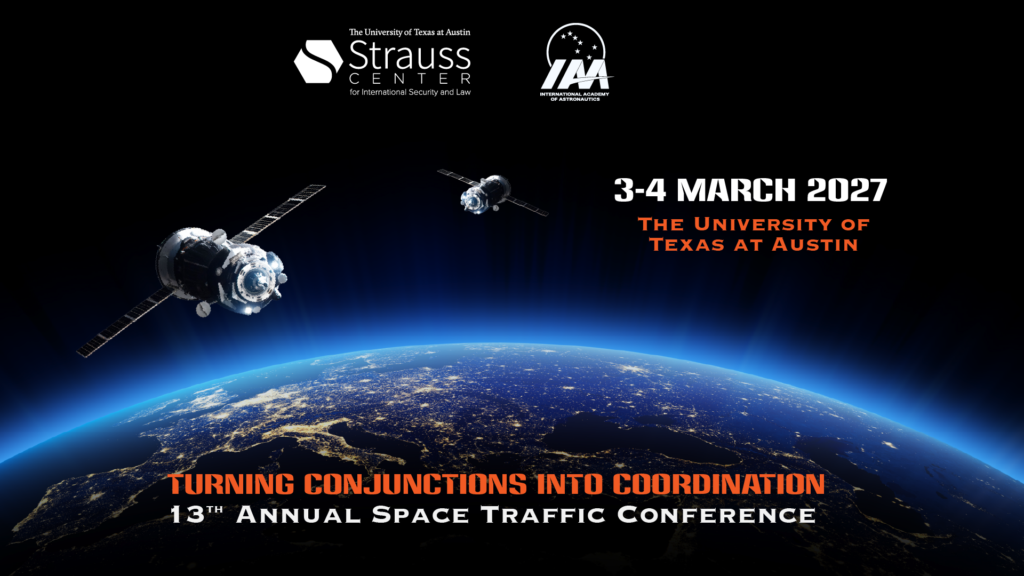
The Space Law and Policy Program at The University of Texas at Austin’s (UT) Strauss Center for International Security and Law, the International Academy of Astronautics (IAA), and UT’s Cockrell School of Engineering will hold the 13th annual IAA/UT Austin Space Traffic conference, “Turning Conjunctions Into Coordination.”
ABSTRAT SUBMITTAL
The call for abstracts has been extended to October 14. Abstracts of up to 500 words are invited and must include the precise title of the paper, the topic area of interest, the author’s full name and affiliation, and complete contact information including an email address. The language of the conference is English. All abstracts must follow the ST Conference paper guidelines and the abstract template. Please send your abstracts to ali.prince@austin.utexas.edu.
CALL FOR PAPERS
We invite researchers, industry experts, policymakers, and students to submit papers for our upcoming 2027 conference — Space Traffic: Turning Conjunctions into Coordination. For the purposes of this conference, we define “conjunctions” as predicted close approaches between two space objects — identified when the miss distance between their trajectories reaches a local minimum — that carry enough collision risk to warrant assessment and, where appropriate, a coordinated avoidance response. This interdisciplinary conference seeks to bring together stakeholder communities to address critical issues with an emphasis on three thematic areas:
Operations: Assess risks and impacts to space traffic from space debris and congestion; propose and evaluate solutions for maneuver coordination and rules of the road; analyze emerging impacts to third parties from space traffic; discuss advancements and challenges in launch and reentry operations and create innovative solutions and policies to maximize efficiency and sustainability, to include recycling and removal as well as controlled reentry; examine technical systems for regulatory compliance assessment and monitoring; evaluate orbital use, capacity, and associated policies/metrics; assess the space traffic implications of emerging large-scale orbital infrastructure, including space-based data centers, computing platforms, and their associated power, communications, servicing, and end-of-life requirements; and evaluate operational concepts for cislunar space traffic, including translunar injection (TLI) and other Earth-departure trajectories, coordination of departure windows and high-energy maneuvers, tracking and custody of objects transitioning from Earth orbit into cislunar space, upper-stage disposition, coordination for the growing traffic to and around the Moon, and rules of the road for a domain with no established norms.
Economy: Characterize economic behavior of current space traffic and future traffic demand; delve into the emerging fields of in-space servicing, assembly, and manufacturing, including rendezvous and proximity operations; examine the emerging economics of space-based data centers and other orbital computing infrastructure, including demand for launch, energy, communications, servicing, and orbital capacity; investigate the role of commercial space situational awareness (SSA) and space traffic coordination; explore integrated assessment models for space traffic; analyze economic impact and results of existing or potential space traffic policies; and explore the concept, viability, and path to a circular space economy; and assess the emerging cislunar economy, including the investment and insurance implications of operating where traffic coordination and liability frameworks are still taking shape.
Ecosystems: Investigate the interactions between systems and infrastructures focusing on, inter alia: spaceports, assured access to space, air/space integration, internationally federated SSA and traffic coordination, information infrastructure, cybersecurity, space-based data centers and computing infrastructure, including their integration with terrestrial cloud, communications, energy, and data networks, impacts and interoperability of legal/policy regimes with each other, as well as with technical considerations for space traffic and cislunar/deep space activities, including the infrastructure and interoperability needed to extend SSA, communications, and navigation support from Earth orbit through translunar injection and cislunar transit to the Moon and beyond. Consider and evaluate possible dual-use approaches to space-based sensor networks in support of threats from uncontrolled reentries.
We welcome papers that present new, forward-thinking perspectives, recommendations, and proposed solutions on these topics. Please submit your abstracts and join us in shaping the future of space traffic and operational assurance for all.
KEY DATES
31 August 2026 Call for Papers distributed
14 October 2026 Abstracts due (Student papers with faculty recommendations will continue to be accepted until 1 November.)
25 October 2026 Registration opens
15 November 2026 Authors notified
30 November 2026 Preliminary program published
20 February 2027 Final papers due
3-4 March 2027 Conference
VENUE
This year’s conference will be held at The University of Texas at Austin TX, USA.
MORE INFORMATION
Visit past year’s conferences and materials at: https://www.strausscenter.org/space-security-stm/.
CONTACT
For more detailed information, please contact Ali Prince, at ali.prince@austin.utexas.edu
.